What we built
A direct Avito channel receives the message and listing context. Product records and stock come from MoySklad. Each conversation has a Telegram topic where managers see the messages and order events and can continue the same conversation.
Connecting messages directly
The shop already had an Avito integration inside MoySklad, but messages lived in a third-party module and were not available through the MoySklad API. We used Avito Messenger API for chat and kept the inventory system as the source for product records and stock.
Listing uploads supplied a link to the product UUID. Where no exact link exists, the system checks both the name and item type. A matching brand alone is insufficient.
A source for every fact
A resale item is a specific physical unit. Stock for another bag of the same model does not establish that the listed one is available. Live stock checks use the ID of the actual listing's product.
The conversation price comes from Avito; stock and condition come from MoySklad. An empty defect field does not mean there are no defects. Unsupported properties and delivery promises are filtered before sending.
The Telegram hub
- 01Link the Avito conversation to a Telegram topic with the product and listing link.
- 02Forward customer messages, bot replies and order events to that topic.
- 03Send ordinary manager messages back to Avito; use // for internal notes.
- 04Confirm a successful send or display a clear error.
- 05Track the system's own outgoing messages to distinguish automated and human replies and stop automatic responses after staff intervention.
A source for every fact
Avito
Listing, price, messages and order status through a separate API.
MoySklad
Product record, stock, description and tasks.
Integration service
Links chat, product and topic; checks duplicates and pauses the agent.
Telegram topic
Context, photos and messages in one place. Staff replies return to Avito.

The working hub on 5 August 2026, in Russian. Each Avito conversation has its own topic; previews show manager replies and new enquiries.
Open full-size image ↗A manager joins the conversation
A buyer asks whether collection is possible. The manager types “Yes, of course” directly in the Telegram topic. The service sends ordinary text from a linked topic to the original Avito conversation, so staff do not need to switch apps.
Below the reply is a separate Copilot suggestion, with a note that the product record was read. It is a draft for the manager to edit and send as another message. Automatic responses stop after the manager intervenes.
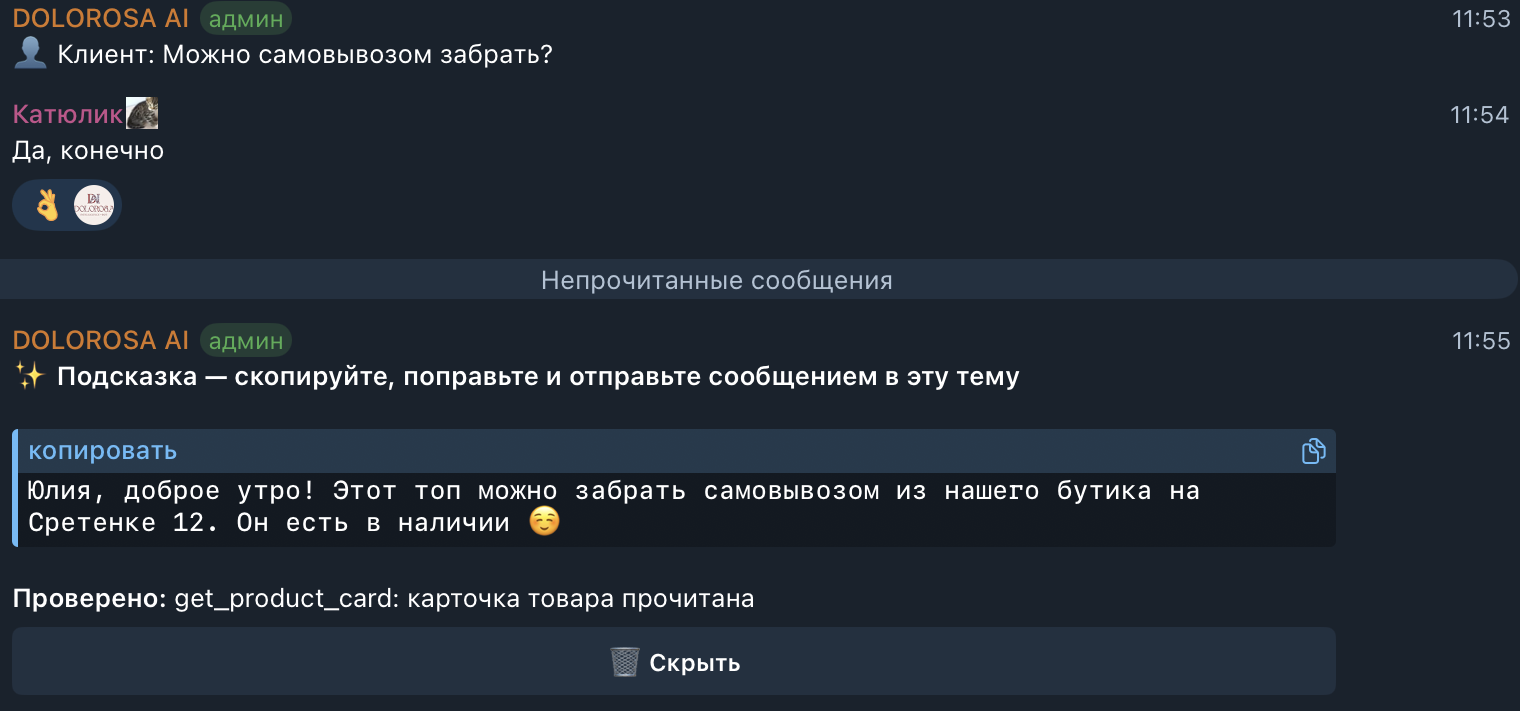
A real conversation on 11 August 2026, in Russian. The manager's reply is above; the Copilot suggestion below has not been sent to the buyer.
Open full-size image ↗Failures that shaped the workflow
The model searched again even when the listed item had already been identified. A timeout could then turn unrelated search results into the answer. Preloaded tool results now reach the verification module, and catalog search is used when the buyer requests alternatives.
The first hub required an explicit send command. Managers typed a normal reply and could not see why it failed to reach the buyer. We made ordinary text the reply and marked internal notes with a prefix. A conflicting old Telegram webhook was handled separately.
From a photo request to a delivery order
In another conversation, the buyer requests more photographs of a cardigan. The bot replies about that item. The buyer then notices the order was placed for collection rather than delivery. The original order is cancelled; after reordering, a new paid-order status reaches the topic and the buyer confirms the change.
The two screenshots below are excerpts from that conversation. The original checkout and cancellation happened between them. The system explicitly marks the cancellation as not a sale and tracks the new order separately.

12 August, 23:05, in Russian. The buyer requests more photos; the bot identifies the cardigan in its reply.
Open full-size image ↗
A later excerpt from the same conversation, 23:20–23:22, in Russian. The buyer has reordered with delivery and the bot acknowledges the new collection method.
Open full-size image ↗A separate photo workflow
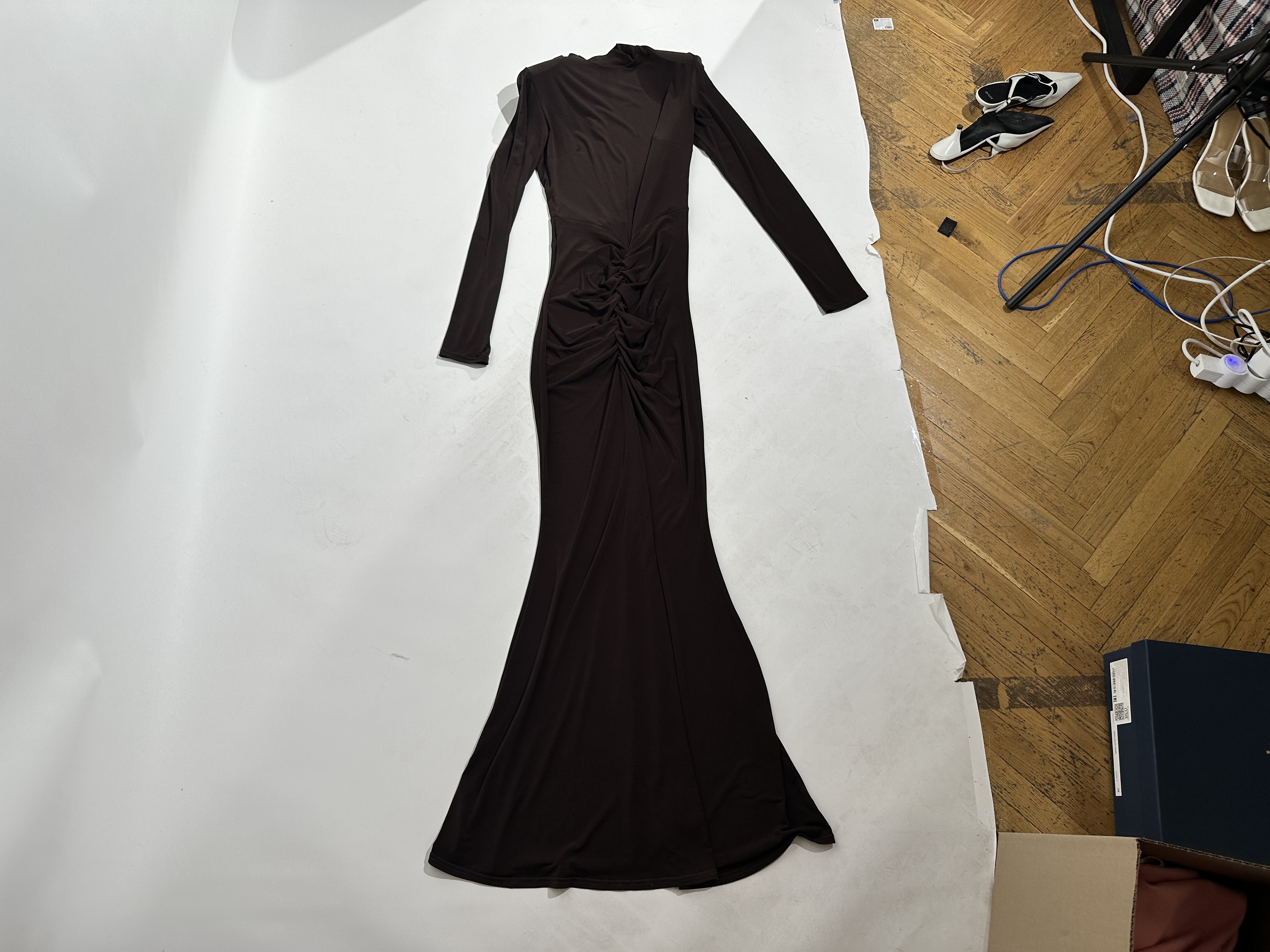
We also built source-photo processing and listing-cover preparation. A person compares the result with the original before publication because generation can alter a defect, a label or an item detail.
The public estimate for that processing is USD 0.10–0.15 per photo. A concrete source set determines the detailed calculation and processing steps.


The operational result
The product, conversation and order stage are visible in one topic. Managers join with the context already available and reply through Telegram. The bot handles questions supported by verified data.
Negotiation, disputes, returns and physical inspection remain with staff. Conversation and order events are reviewed separately from the number of generated replies.